The Multi-Platform Dilemma: Android, iOS, and Web
For any growing business today, having a mobile app alongside a responsive website is no longer a luxury—it is an operational necessity. Whether you run a retail brand, a healthcare clinic, a real estate agency, or a logistics company, customers expect to interact with your services effortlessly across smartphones and desktop browsers.
However, traditional development forces business owners into an expensive dilemma: building three separate codebases. Hiring one team for native Android (Kotlin), another for native iOS (Swift), and a third for the web multiplies both upfront development fees and long-term maintenance costs. This is where cross-platform engineering—specifically Google’s Flutter—fundamentally changes the economics of software development.
What Makes Flutter a Game-Changer for Business Owners?
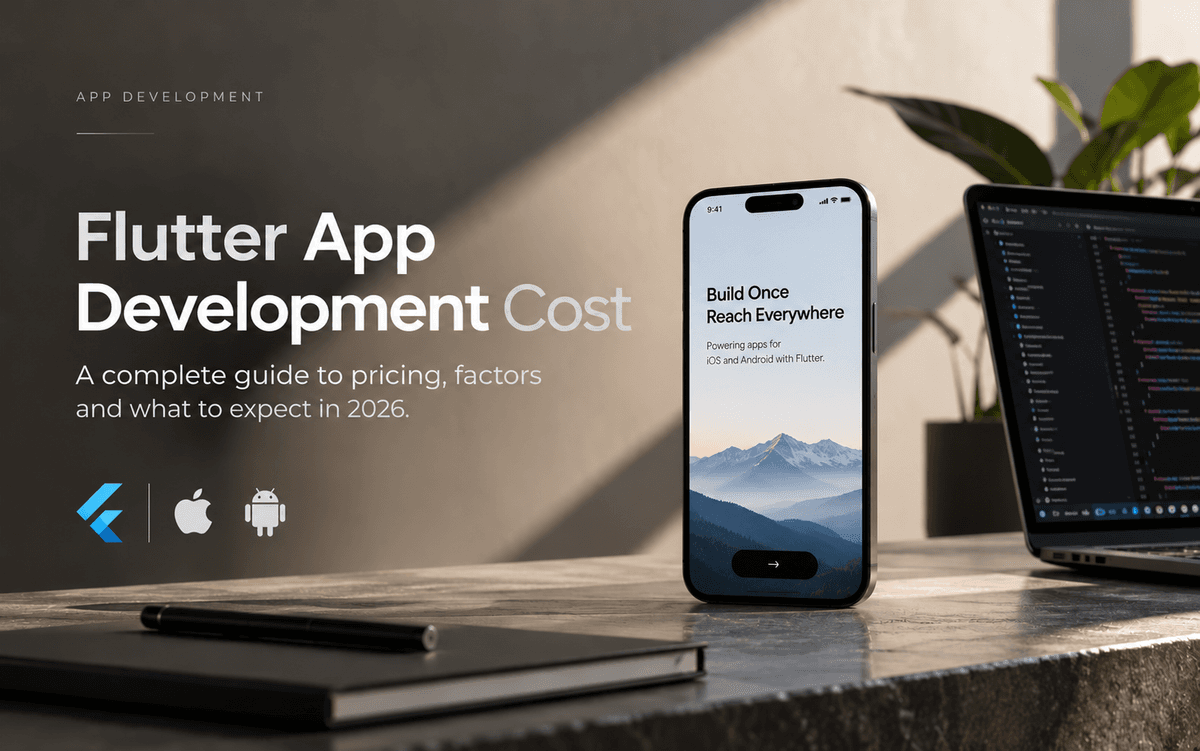
Flutter is an open-source UI toolkit created by Google that allows engineers to build natively compiled applications for mobile (Android & iOS), web, and desktop from a single codebase. Instead of writing repetitive logic for each operating system, your entire product logic and UI are developed once.
Here is how that translates into measurable business advantages:
- Up to 40% Lower Development Costs: Because engineers write one core codebase instead of two or three, your required developer hours drop drastically.
- 50% Faster Time-to-Market: Launch your MVP (Minimum Viable Product) across the Google Play Store and Apple App Store simultaneously ahead of competitors.
- Unified Brand Experience: Buttons, animations, brand colors, and navigation work with pixel-perfect consistency across all user screen sizes.
- Simplified Ongoing Maintenance: Fixing a bug or adding a promotional banner is done once, immediately reflecting across Android, iOS, and web interfaces.
The Winning Architecture: Flutter Frontend + Laravel Backend
A common question founders ask is: “If Flutter handles the app interface, what powers the business logic, customer database, and payments behind the scenes?”
The industry standard formula for scalable, enterprise-grade platforms is pairing a Flutter frontend with a Laravel backend.
While Flutter renders smooth 60fps user screens, Laravel acts as the secure engine room. Laravel manages your database, authentication, role-based user access, push notification dispatchers, third-party payment gateways, and CRM integrations via lightning-fast RESTful APIs. This decoupled architecture ensures that even if you handle hundreds of thousands of concurrent daily users, your application remains stable, secure, and infinitely scalable.
When Should Your Business Choose Flutter?
Flutter is the ideal technical choice for:
- Customer-Facing Mobile Apps: E-commerce stores, on-demand delivery apps, service booking engines, and fitness trackers.
- Internal Business Dashboards: Field staff trackers, warehouse inventory apps, and order fulfilment consoles that need to run seamlessly on both office laptops and staff smartphones.
- Early-Stage Startups & MVPs: Startups needing to validate business ideas on both app stores without burning through their entire runway.
Note for Public Portals: If your primary objective is public search engine ranking (SEO) for a corporate website or content-heavy blog, pair your Flutter mobile apps with a dedicated server-rendered web frontend like Next.js, powered by the same backend APIs.
Build Scalable Digital Products with Webeez
Choosing the right technical foundation early prevents expensive rewrites down the road. At Webeez, we help businesses across Kerala and beyond plan, design, and engineer custom web platforms, mobile apps, and automated workflows engineered for measurable business growth.
Ready to launch your mobile app or modern web platform? Start a Project with Webeez today and let our engineering team guide you through the right roadmap.