A Historic Moment from the Heart of Kerala
In April 2026, a woman from Kannur — a coastal district in northern Kerala — made history on the world stage of open source technology. Sruthi Chandran was elected the Debian Project Leader (DPL) for 2026, becoming the first woman and the first Asian person ever to hold this position in Debian's more than 30-year history.
Her term officially began on April 21, 2026, succeeding outgoing leader Andreas Tille, who chose not to seek a second term. Sruthi ran unopposed — a quiet but powerful signal of the trust the global Debian community placed in her — and was confirmed following the required voting quorum formalities.
She describes herself simply on her election platform page as a "librarian turned Free Software enthusiast and Debian Developer." That description, modest as it sounds, tells the story of one of the most remarkable journeys in the history of Indian technology.
Who Is Sruthi Chandran?
From a Library in Kannur to Leading the World's Most Respected Linux Project
Before Sruthi Chandran became a globally recognized name in free software, she was a librarian. Not a software engineer. Not a computer science graduate on a straight-line career path. A librarian — someone whose profession is built on the belief that knowledge should be freely accessible to all. In hindsight, it is the most fitting origin story possible for someone who would go on to lead a project whose entire philosophy rests on exactly that principle.
Sruthi began contributing to Debian in 2016, working on Ruby, JavaScript, Go, and font packages. Her contributions were steady, committed, and community-focused. In 2019, she made history by becoming the first Indian woman to achieve the rank of Debian Developer — at a time when the entire country of India had only two women Debian Developers out of more than a thousand active contributors worldwide.
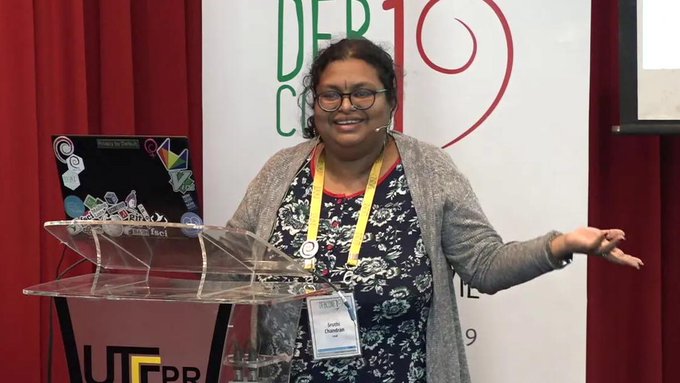
She did not stop there. Over the following years, she built one of the most well-rounded contributor profiles in the Indian Debian community:
- Community Team Delegate since August 2020
- Application Manager since July 2020, reviewing and mentoring new Debian Developer applications
- Outreach Team Member since August/September 2020
- Chief Organizer of DebConf India 2023 — the prestigious global Debian conference held in India
- DebConf Committee Member since 2023
- 200+ software packages maintained across Ruby, JavaScript, and Go ecosystems
- Years of packaging workshops across India, where women often made up more than 50% of attendees — though very few remained active contributors long-term, a gap she has consistently worked to close
Her Vision as Debian Project Leader
Sruthi Chandran enters the DPL role with a clear, grounded plan. She has identified three priority areas:
- Reducing Leader Burnout
The Debian Project Leader role has increasingly become a path to exhaustion. Sruthi plans to form a team of "DPL helpers" — volunteers who assist with daily administrative tasks so the leader can focus on strategic priorities rather than being consumed by operational work.
- Refreshing Delegated Teams
She intends to review and revitalize Debian's many delegated teams, ensuring they remain active, effective, and representative.
- Diversity — Everywhere, Not Just in Sub-Committees
This is where Sruthi's voice is most distinctive and urgent. She has been unequivocal: diversity is not a conversation to be confined to Debian-women or Debian-diversity sub-groups. It must be part of every conversation, every team review, every election cycle, and every aspect of the project. She has stated that she plans to raise diversity issues at every DPL election until Debian has a non-cisgender-male Project Leader as a matter of course, not as a historic exception.
"I am sad that there are only two women Debian Developers from a large country like India. Diversity is not something to be discussed only within Debian-women or Debian-diversity. It should come up for discussion in each and every aspect of the project."
— Sruthi Chandran, Debian Project Leader Platform 2026
She has also noted that at DebConf 2019, only about 32 of over 1,000 active Debian Developers were women — roughly 0.3%. While this represented a ten-fold improvement from fifteen years prior, she considers it nowhere near sufficient, and she is now in a position to act on that belief at the highest level.
What Is Debian? The Operating System the Internet Runs On
To fully appreciate why Sruthi Chandran's election matters, it helps to understand the weight of what she now leads. Debian is not a niche project or a footnote in computing history. It is one of the most consequential pieces of software infrastructure in the world.
Founded in 1993: Ian Murdock's Open Vision
Debian was officially founded on August 16, 1993 by Ian Murdock, a student at Purdue University in the United States. The name itself is a portmanteau — "Deb" from Debra Lynn, his then-girlfriend, and "Ian" from his own name. At the time, the idea of a "Linux distribution" was entirely new. Murdock saw that the early Linux ecosystem was fragmented, poorly maintained, and riddled with bugs. He set out to build something different.
His founding document, the Debian Manifesto, laid out a vision that was radical for 1993: an operating system built entirely by volunteers, entirely on free software principles, maintained openly in the spirit of Linux and GNU, and guided by the community rather than any corporation. The very first internal release, Debian 0.01, was published on September 15, 1993.
By 1994, dozens of contributors were each maintaining their own packages — a distributed ownership model that was genuinely novel. By early 1995, when Debian 0.93R5 was released, this model had taken root permanently.
The Three Documents That Govern Debian
Unlike virtually every major software project, Debian is not controlled by a company. It is governed by three foundational documents that have guided the project for nearly three decades:
The Debian Social Contract defines the ethical commitments of the project — to its users, to the free software community, and to the world. It is a public pledge that Debian will always remain free, always prioritize its users, and never compromise its principles for commercial convenience.
The Debian Free Software Guidelines (DFSG) defines precisely what "free software" means within the project. These guidelines were so well-crafted and so universally respected that they were adopted almost verbatim as the Open Source Definition — the foundational document of the entire global open source movement. Every time someone talks about "open source software," they are working within a framework that Debian helped create.
The Debian Constitution describes the organizational structure of the project: the powers and responsibilities of the Debian Project Leader, the Secretary, and all other roles. It is what makes Debian a true democracy of contributors rather than a hierarchy of ownership.
Debian's Milestones — Three Decades of Building the Digital World
- August 1993 — Ian Murdock announces the Debian Project. The first internal releases follow in September and December 1993.
- January 1994 — Debian 0.91 is released with the first primitive package management system, allowing users to manipulate packages — the ancestor of the apt system used by hundreds of millions of people today.
- June 1996 — Debian 1.1 "Buzz," the first official stable release, arrives with 474 packages and Linux kernel 2.0 support. The tradition of naming Debian releases after Toy Story characters begins here and continues to this day.
- November 1994 – November 1995 — The Free Software Foundation, co-founded by Richard Stallman, sponsors Debian — an early endorsement of its principles.
- 1997 — The Debian Free Software Guidelines are published and immediately adopted as the Open Source Definition. Debian's philosophical contribution to computing becomes permanent and global.
- 1997 — Software in the Public Interest (SPI) is founded, giving Debian a legal and financial structure as a non-profit that can accept donations and hold trademarks.
- 2004 — Ubuntu launches, built directly on Debian. This brings Debian's rock-solid foundation to mainstream users worldwide and spawns an entire family of distributions used by millions.
- 2006 — The Debian India community holds its earliest events. Indian developers join across various roles. Debian is made partially or fully available in 11 Indian languages.
- 2019 — Sruthi Chandran from Kannur, Kerala becomes the first Indian woman to achieve Debian Developer status.
- 2023 — DebConf India 2023 is held in India, with Sruthi Chandran as Chief Organizer.
- April 21, 2026 — Sruthi Chandran is elected Debian Project Leader — the first woman and first Asian to hold the role.
Debian Today: Scale and Significance
As of early 2026, Debian maintains more than 94,000 free software packages, supported by over 1,400 active contributors working entirely as volunteers. There are 379 mirror servers distributing Debian to every corner of the world.
More than 300 Linux distributions have been built on top of Debian's foundation — including Ubuntu, Linux Mint, Kali Linux, and elementary OS. Debian powers servers, laptops, cloud infrastructure, Docker
containers, AI development environments, and Google Cloud's deep learning virtual machines. When you use the web — when you load a website, stream a video, or send a message — there is a significant chance that Debian is somewhere in the chain keeping it running.
It is, in every honest sense, a cornerstone of the modern internet.
Why This Matters for Kerala, India, and the World
The Representation Gap in Open Source
Open source software has a well-documented diversity problem. The numbers Sruthi herself has cited make it concrete: at the time of the 2026 election, only two women in all of India held Debian Developer status out of more than a thousand active contributors globally. In a country of 1.4 billion people — a global technology powerhouse — two.
Sruthi's election does not fix this gap. But it makes it visible in a way that is impossible to ignore. When the leader of one of the world's most important software projects is a woman from Kannur, Kerala, the conversation about who belongs in open source changes. Role models matter. Visibility matters. And Sruthi has made it clear she intends to use her platform not just to lead Debian's technical operations, but to ensure that the question of who gets to participate is asked loudly and answered honestly.
A Kerala Story
Kannur is known for Theyyam, its ancient ritual art forms, its coastline, its community solidarity, and its deep traditions of public education. It is perhaps fitting that the woman who will argue for open access and shared knowledge in the world's largest free software project comes from a place with such a powerful tradition of both culture and community.
From the perspective of Kerala's technology community — and Webeez as a digital agency rooted in Kochi — this is a moment of enormous pride. One of our own has not just entered the global stage of technology leadership. She has changed what that stage looks like.
A Note from Webeez
At Webeez, a digital agency based in Kochi, Kerala, we tell the stories of people and ideas shaping the digital world — especially when those stories begin close to home. Sruthi Chandran's journey from librarian in Kannur to Debian Project Leader is one of the most compelling technology stories to come out of Kerala in a long time, and it deserves to be told fully and well.
Debian's founding philosophy — that software should be free, community-driven, and built for people rather than profit — resonates with how we think about the work we do: crafting digital experiences that are honest, functional, and built to last. We congratulate Sruthi Chandran and look forward to watching her shape the future of open source.
Quick Facts — Sruthi Chandran & Debian
= Debian Project Leader (DPL) 2026
First Indian woman Debian Developer
Contributing to Debian since
= 200+ (Ruby, JavaScript, Go, fonts)
= August 16, 1993 by Ian Murdock
Active Debian contributors
Distributions built on Debian