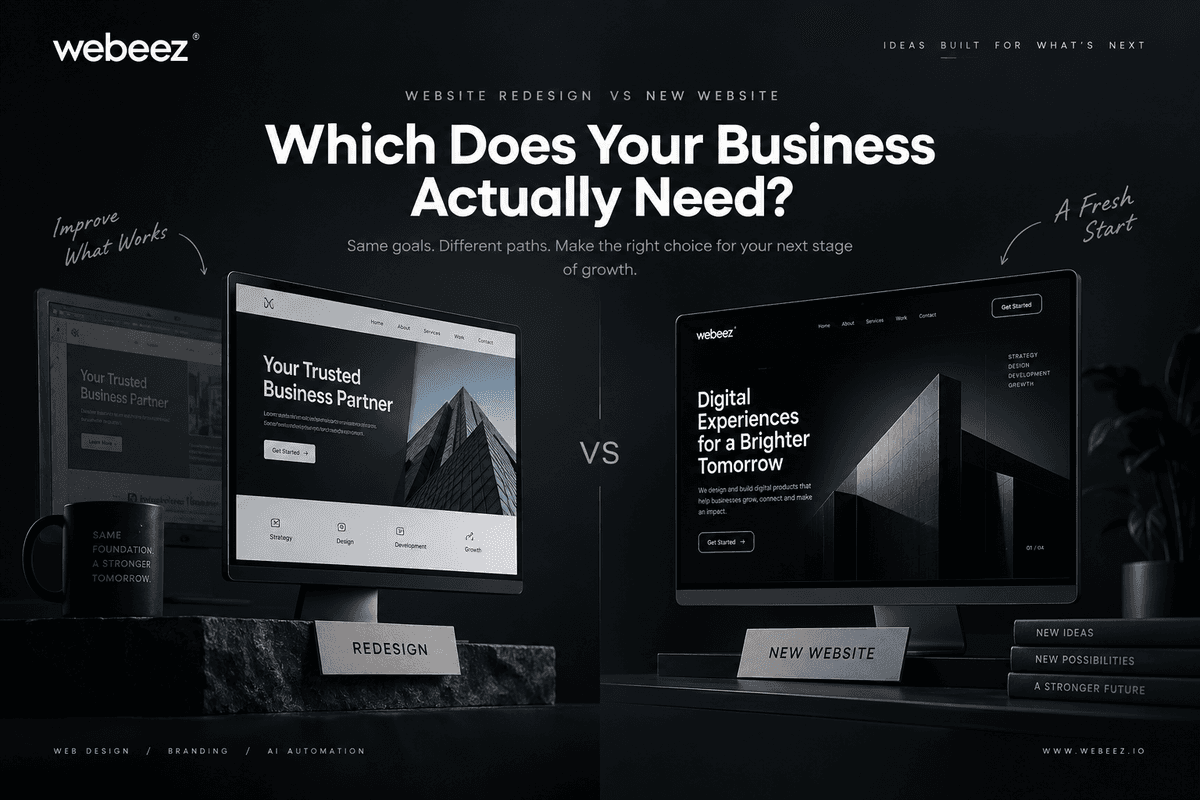
Your Website May Not Need a Complete Rebuild
When a business website starts looking outdated, the first thought is often simple: “We need a new website.”
But that is not always the right answer.
Sometimes the existing website has a solid foundation and only needs a strategic redesign. In other cases, the technology, structure and user experience are so outdated that rebuilding from the ground up makes more sense.
The difference matters because a redesign and a new website solve different problems.
A redesign improves an existing foundation. A new website creates a new foundation.
So how do you know which one your business actually needs?
The answer depends on your current website, your business goals, your technology, your content structure and what you want the website to do in the future.
What Is a Website Redesign?
A website redesign means improving an existing website without necessarily throwing away everything that already works.
The visual design may change completely, while useful content, URLs, business information, integrations or parts of the existing technical structure can sometimes be retained.
A professional redesign can include:
- New UI/UX design
- Better navigation
- Improved mobile experience
- Stronger content structure
- Better calls to action
- Faster page loading
- Updated branding
- Improved accessibility
- Better internal linking
- SEO improvements
- Conversion-focused page layouts
The important point is that redesign is not simply changing colours, fonts and images.
A successful redesign improves how the website communicates, performs and helps visitors take action.
What Is a Completely New Website?
A new website is built when the existing foundation is no longer suitable for the business.
Instead of modifying the current structure, the project starts with a new sitemap, content architecture, design system and technical implementation.
This approach can make sense when:
-The existing technology is outdated
- The website has serious technical limitations
- The CMS is difficult to maintain
- The current structure does not support the business anymore
- The website needs complex new functionality\
- Performance problems are difficult to solve
- The brand has changed significantly
- The business needs a completely different digital experience
A new website gives the business an opportunity to rethink everything from the information architecture to the technology stack.
When a Website Redesign Makes More Sense
You may not need to start from zero.
A redesign can be the better approach when the existing website still has useful foundations.
For example, your current website may already have valuable Google rankings, useful content, established URLs, customer recognition and a functioning CMS.
If the main problems are visual quality, user experience, mobile responsiveness, navigation or conversion flow, these issues can often be addressed through a strategic redesign.
A redesign is particularly useful when:
- The website looks outdated but still functions properly
- The brand has evolved
- Mobile experience needs improvement
- Navigation is confusing
- Visitors cannot find important information quickly
- Calls to action are unclear
- Pages are difficult to update
- The design no longer represents the quality of the business
- Performance can be improved without replacing the entire system
The goal is to preserve what is valuable while improving what is holding the website back.
When You Should Consider a Completely New Website
Sometimes redesigning the surface is not enough.
If the underlying architecture is causing the problems, continuously modifying the existing website can become more complicated than rebuilding it.
A new website may be appropriate when:
- The technology is outdated
- The current CMS cannot support your requirements
- The website has accumulated too many plugins or dependencies
- The information architecture is fundamentally wrong
- The business model has changed
- You need new systems or integrations
- The website needs a custom dashboard or application
- Performance problems are built into the current architecture
- Security and maintenance have become difficult
- The current website cannot scale with the business
For example, a company that previously needed only five informational pages may now need service pages, case studies, booking systems, CRM integration, customer dashboards or e-commerce functionality.
At that point, rebuilding the digital foundation may be more practical than continuously modifying the old one.
Redesign vs New Website: The Real Difference
The simplest way to understand the difference is to look at the foundation.
A redesign asks:
“What can we improve while keeping useful parts of the existing website?”
A new website asks:
“What should the website be if we were building it properly for the business today?”
Neither approach is automatically better.
The right choice depends on the condition of the existing website and the direction of the business.
Redesign vs New Website
Existing foundation
Redesign: Can often retain useful parts
New website: New structure and foundation
Design & UX
Redesign: Improved or completely refreshed
New website: Designed from the beginning
Technology
Redesign: Existing technology may remain
New website: Technology selected around new requirements
Content
Redesign: Useful content can be reviewed and retained
New website: Content structure can be rebuilt
SEO
Redesign: Existing search value should be protected
New website: SEO architecture should be planned from the start
Best suited for
Redesign: An existing website with a workable foundation
New website: An outdated or fundamentally unsuitable website
5 Signs Your Website Probably Needs a Redesign
- Your website looks outdated
Your business may have evolved, but the website still looks like it belongs to another era. An outdated visual system can make the business feel less relevant even when the actual service quality is strong.
- The mobile experience is poor
Most website visitors use mobile devices. If menus are difficult to use, text is hard to read, buttons are too small or layouts break on smaller screens, the website needs attention.
- Visitors cannot understand what you offer
A website should make the business easy to understand. If visitors have to search through several pages to understand your services, pricing approach, process or next step, the information architecture may need to be redesigned.
- The website does not represent your current brand
Businesses evolve. New services are introduced, target customers change and positioning becomes more sophisticated. Your website should reflect the business you are today, not the business you were several years ago.
- Your website gets attention but does not create action
A website can look attractive and still have weak enquiry paths. If visitors are not being guided toward calls, WhatsApp messages, forms, bookings or other meaningful actions, the UX needs to be reconsidered.
5 Signs You May Need a Completely New Website
- The technology is holding the website back
If the current platform makes basic improvements difficult, the technical foundation may need to change.
- The website has become difficult to maintain
Constant plugin conflicts, broken layouts, outdated dependencies or complicated updates can indicate that the current architecture is no longer practical.
- Your business needs completely new functionality
Adding a simple contact form is very different from adding a booking engine, customer dashboard, e-commerce system, CRM integration or custom business application.
- The current structure is fundamentally wrong
If the sitemap, navigation and content architecture no longer match the way customers understand the business, redesigning individual pages may not solve the deeper problem.
- The business has changed significantly
A company that has changed its services, market, positioning or business model may need a digital experience built around its new direction.
Don't Redesign Just Because the Website Looks Old
Visual age is only one part of the problem.
Before deciding on a redesign or rebuild, look at the website as a complete digital system.
Ask:
Does it communicate the business clearly?
Is the navigation easy to understand?
Does it work properly on mobile?
Is the website fast?
Can your team update content easily?
Does the current technology support your future requirements?
Are important pages indexed correctly?
Are existing URLs generating search traffic?
Are visitors reaching the right enquiry points?
Does the website reflect your current brand?
These questions give you a much better picture than simply asking whether the website “looks modern.”
What Happens to SEO During a Website Redesign?
This is one of the most important considerations.
An existing website may already have search visibility, backlinks, indexed pages and valuable content. Replacing the website without planning for these assets can create unnecessary SEO problems.
A redesign or rebuild should therefore consider:
- Existing URL structure
- Important indexed pages
- Redirect requirements
- Metadata
- Internal links
- Heading structure
- Image optimisation
- Sitemap
- Canonical URLs
- Structured data where relevant
- Search performance before and after launch
The objective is not simply to launch a prettier website.
The objective is to improve the website without unnecessarily losing the search value the business has already built.
For larger redesigns, an SEO-safe migration plan should be prepared before the new website goes live.
Redesign Is Not Just a Visual Makeover
One of the most common mistakes businesses make is treating redesign as a cosmetic exercise.
Changing the logo, colours, fonts and images can make a website look different, but it does not automatically make it better.
A proper redesign should examine:
- Information architecture
- User journeys
- Content hierarchy
- Mobile usability
- Conversion paths
- Page performance
- Accessibility
- SEO structure
- Brand consistency
- Calls to action
The visual layer is only one part of the experience.
The real objective is to make the website easier to understand, easier to use and more effective for the business.
What a Modern Website Redesign Should Improve
A modern redesign should ideally improve several areas at the same time.
Clarity
Visitors should understand what the business offers and who it serves quickly.
Navigation
Important information should be easy to find without unnecessary clicks.
Trust
Testimonials, case studies, certifications, team information and other relevant proof should appear where they help the visitor make a decision.
Conversion
The website should provide clear next steps such as enquiry forms, calls, WhatsApp messages, bookings or consultations.
Performance
Pages should load efficiently across devices, especially mobile.
Search visibility
The website should have a clean structure that supports search engines and future content growth.
Scalability
The website should be able to accommodate new services, pages, content and features as the business grows.
How to Decide: Redesign or Rebuild?
Use this simple framework.
If the foundation works but the experience feels outdated → consider a redesign.
If the technology works but the UX and content structure are weak → redesign may be enough.
If the technology itself is limiting the business → consider a rebuild.
If you need completely new functionality → a new website may be more practical.
If the business has completely repositioned itself → rebuilding the digital experience may make more sense.
If the website already has valuable search visibility → protect that value carefully before making major changes.
The answer should come from an audit of the existing website, not from a preference for one technology or design style.
The Best Website Is the One That Supports Where Your Business Is Going
A website should not only represent where your business is today.
It should provide a foundation for where the business is going next.
For some companies, that means taking an existing website and giving it a better user experience, stronger content structure and modern visual system.
For others, it means starting again with a new architecture, new technology and a completely different digital experience.
The important thing is to make that decision based on evidence.
Audit the current website.
Understand what is working.
Identify what is failing.
Protect what has value.
Then decide whether the right solution is a redesign or a complete rebuild.
How Webeez Approaches Website Redesign
At Webeez, we do not treat every outdated website as a reason to start from zero.
We first look at the existing experience, structure, content, performance and business requirements.
The process can include:
Discovery and audit
We understand the business, target audience, existing website and current problems.
UX and content structure
We identify navigation issues, content gaps, unclear journeys and opportunities to improve the visitor experience.
Visual redesign
We create a modern interface that aligns with the brand while keeping usability and performance in focus.
Development and optimisation
The redesigned experience is implemented with responsive layouts, performance considerations and the appropriate technology.
SEO and migration checks
Where an existing website is being replaced or substantially restructured, we review URLs, redirects, metadata, internal links and other important SEO considerations.
Launch and support
After testing across devices and key user journeys, the website is launched and can continue to evolve with the business.
Final Thoughts
The question is not simply “Should we get a new website?”
The better question is:
“What does our business actually need from its website now?”
If your existing website has a strong foundation, a strategic redesign may be enough.
If the foundation is outdated, difficult to maintain or incapable of supporting the next stage of your business, a complete rebuild may be the better path.
Before making the decision, audit the website, understand the problems and define what the new experience needs to achieve.
A website should not be rebuilt simply because it looks old.
It should be redesigned or rebuilt because the business has a better digital experience to build.