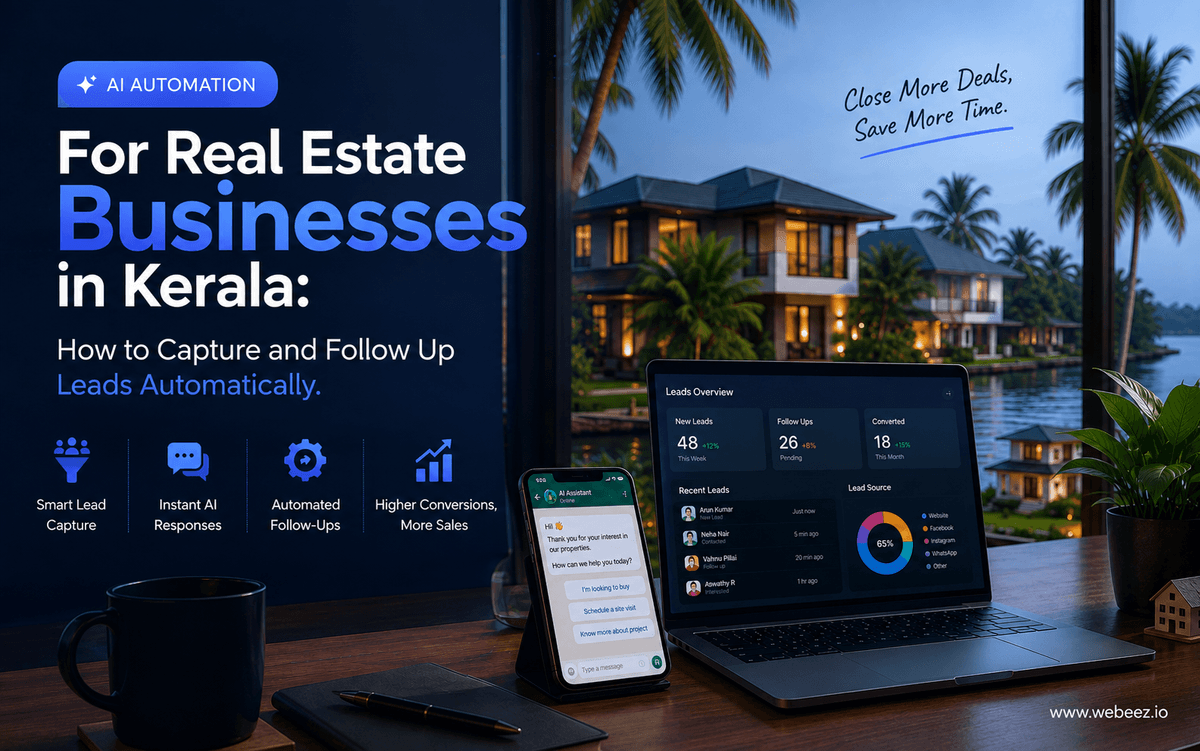
AI Automation for Real Estate Businesses in Kerala
Real estate businesses in Kerala can receive enquiries from many different channels.
A potential buyer may discover a property through Google, Instagram, Facebook, a property portal, a website, a Google Business Profile listing or a WhatsApp conversation. Some customers may ask for the price immediately. Others may want location details, floor plans, amenities, availability or a site visit before they are ready to speak with a sales representative.
The challenge is not always generating enquiries.
The bigger challenge is handling those enquiries quickly and consistently.
A customer who sends a property enquiry today may be contacting several developers, builders or agents at the same time. If the first response takes too long, the opportunity can easily move elsewhere.
This is where AI automation for real estate businesses can become useful.
Instead of relying entirely on a sales team to manually check messages, collect customer details, update records and remember follow-ups, businesses can connect their website, WhatsApp, CRM and sales workflows into a more organized system.
The goal is not to replace real estate professionals.
The goal is to help them spend less time on repetitive enquiry handling and more time having meaningful conversations with serious prospects.
Why Real Estate Lead Follow-Up Is Difficult
Real estate enquiries are rarely simple.
A customer may ask:
- What is the price of this property?
- Is this apartment still available?
- Where exactly is the project located?
- What is the starting price?
- How many bedrooms are available?
- Is there parking?
- Can I schedule a site visit?
- Is there a payment plan?
- Can you send the brochure?
- Do you have similar properties in another location?
Each question can become the beginning of a longer sales conversation.
At the same time, the sales team may be dealing with existing customers, property visits, phone calls and multiple new enquiries.
When everything is handled manually, several problems can appear:
- Enquiries may receive delayed responses.
- Customer information may be incomplete.
- Follow-ups may be forgotten.
- Different team members may handle the same lead.
- Important conversations may remain inside personal WhatsApp accounts.
- Sales teams may spend time answering repetitive questions.
- Managers may have limited visibility into the overall lead pipeline.
A properly designed automation workflow can reduce many of these problems.
What Is AI Automation for Real Estate?
AI automation for real estate is the use of AI-powered tools and business workflows to assist with repetitive activities across the property sales process.
For example, a system can:
- Capture a new property enquiry.
- Ask the customer for basic requirements.
- Understand and organize the responses.
- Identify important lead information.
- Save the information in a CRM or database.
- Notify the appropriate sales representative.
- Send relevant information to the customer.
- Trigger a follow-up reminder.
- Hand the conversation to a human when necessary.
The important part is that AI should not operate as an isolated chatbot.
It should be connected to the actual business workflow.
A useful real estate automation system can connect the website, messaging channels, CRM and sales team into one practical process.
1. Capture Property Enquiries Automatically
The first step is capturing the enquiry.
A real estate website may receive leads through:
- Property enquiry forms
- WhatsApp buttons
- Website AI agents
- Contact forms
- Project landing pages
- Campaign landing pages
- Google Business Profile
- Social media campaigns
Instead of allowing these enquiries to remain scattered across different channels, automation can bring the information into a structured workflow.
For example, when someone enquires about an apartment project, the system can capture:
- Name
- Phone number
- Property interested in
- Preferred location
- Property type
- Budget range
- Number of bedrooms
- Purchase timeline
- Other requirements
This gives the sales team useful context before the first conversation.
2. Qualify Leads Before the Sales Team Steps In
Not every property enquiry has the same level of buying intent.
Someone may simply be researching properties.
Another customer may already have a budget, preferred location and a specific timeline.
AI automation can help collect and organize this information before the salesperson spends time on the lead.
For example, a real estate workflow could ask:
What type of property are you looking for?
- Apartment
- Villa
- Plot
- Commercial property
Then:
Which location are you interested in?
And:
What is your approximate budget range?
Finally:
When are you planning to buy?
The answers can be stored against the lead.
This does not mean AI should make the final sales decision.
Instead, it gives the sales team better information so they can prioritize conversations.
3. Respond to New Enquiries Faster
Speed matters when a customer is actively searching for a property.
If someone submits an enquiry while the sales team is busy or outside normal working hours, an automated system can acknowledge the enquiry immediately.
For example:
“Thanks for your enquiry. We’ve received your property requirements. To help us suggest suitable options, could you share your preferred location and approximate budget?”
The message does not need to pretend that a human salesperson is responding.
It simply confirms that the enquiry has been received and starts collecting useful information.
Once the lead is qualified, the system can notify the appropriate sales representative.
4. Connect Website AI Agents With Real Estate Enquiries
A website AI agent can do more than answer generic questions.
For a real estate business, it can help visitors:
- Understand property details
- Find project information
- Ask about amenities
- Share their requirements
- Request a brochure
- Ask about availability
- Request a callback
- Request a site visit
- Start a WhatsApp conversation
For example, a visitor looking at a residential project could ask:
“Do you have a 3 BHK available?”
The AI agent can provide information that has been configured for the project and then guide the visitor toward the next step.
If the visitor wants to speak with a salesperson, the conversation can be handed over to a human.
This human handoff is important.
AI should assist the sales process, not trap customers inside an automated conversation.
5. Automate WhatsApp Lead Follow-Up
WhatsApp can be an important communication channel for real estate businesses.
A customer may enquire about a property and then become busy. Without a follow-up system, the conversation can easily become inactive.
An automation workflow can help manage follow-up actions such as:
- Initial enquiry response
- Requirement collection
- Brochure sharing
- Site visit reminders
- Callback reminders
- Follow-up notifications
- Re-engagement messages
The exact timing and message sequence should be based on the business's sales process.
Automation should also include rules for when a salesperson needs to take over.
For example, if a customer asks a complex question or requests negotiation, the system can stop automated messaging and notify the sales team.
6. Keep the CRM Updated Automatically
One of the most repetitive tasks for sales teams is updating customer records.
After every conversation, someone may need to manually enter:
- Customer name
- Phone number
- Property interest
- Budget
- Location
- Lead status
- Conversation notes
- Next follow-up date
AI automation can help create or update these records based on information collected through forms and conversations.
The result is a cleaner pipeline.
A sales manager can see which leads are:
- New
- Contacted
- Qualified
- Site visit requested
- Site visit completed
- Negotiating
- Converted
- Not currently interested
The exact stages can be customized around the company's existing sales process.
7. Automatically Route Leads to the Right Person
Real estate companies may have multiple sales representatives or teams.
Not every enquiry should necessarily go to the same person.
Automation can use business rules to route leads based on factors such as:
- Property type
- Location
- Project
- Lead priority
- Sales team
- Language
- Working hours
For example, a lead interested in a particular project can automatically be assigned to the salesperson responsible for that project.
This reduces manual coordination and makes ownership clearer.
8. Use AI to Summarize Conversations
Long conversations can become difficult for sales teams to review.
A customer may send several WhatsApp messages explaining their requirements, budget, preferred location and timeline.
Instead of asking a salesperson to read the entire conversation before making a call, AI can create a concise summary.
For example: Lead Summary
- Interested in: 3 BHK apartment
- Preferred location: Kochi
- Budget: Customer-provided range
- Timeline: Within the next few months
- Requirement: Parking and nearby schools
- Next action: Schedule a call
The salesperson can then start the conversation with context instead of asking the customer to repeat everything.
9. Automate Site Visit Requests and Reminders
A site visit is an important stage in many property sales journeys.
A website or AI agent can collect a preferred date and time from the customer and pass the request to the appropriate team.
The system can also help with:
- Confirmation messages
- Reminder notifications
- Customer details
- Salesperson notifications
- Follow-up tasks after the visit
The actual scheduling logic should remain connected to the business's availability and approval rules.
Automation should not promise a site visit time that the team has not confirmed.
10. Know When AI Should Stop and a Human Should Take Over
Good automation is not about automating everything.
Some real estate conversations require human judgement.
Examples include:
- Price negotiation
- Complex property questions
- Legal questions
- Custom payment discussions
- Complaints
- High-value prospects
- Sensitive customer situations
- Final purchase decisions
A reliable workflow should therefore have clear human handoff rules.
For example:
Customer asks a basic property question → AI responds.
Customer shares requirements → AI qualifies the enquiry.
Customer requests a site visit → system creates a task for the sales team.
Customer wants to negotiate the price → human salesperson takes over.
This keeps AI useful while keeping important business decisions under human control.
A Practical Real Estate AI Automation Workflow
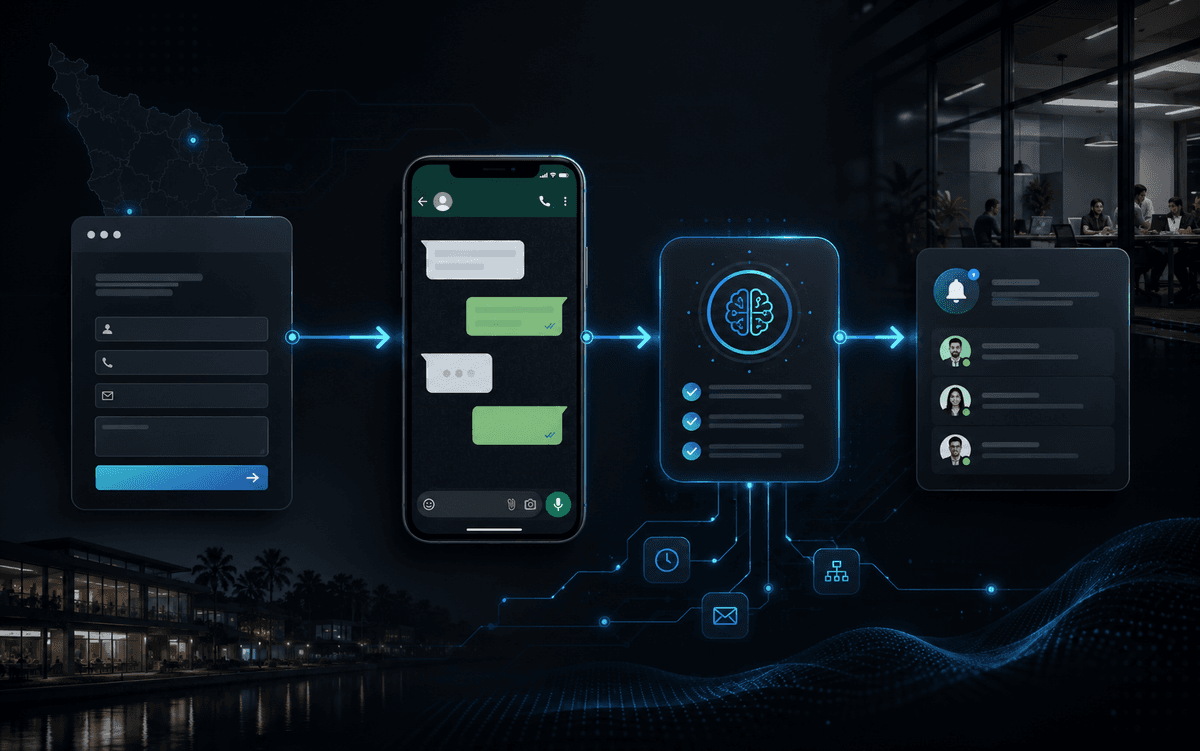
A simple workflow could look like this:
Website / WhatsApp / Social Media
↓
New Property Enquiry
↓
AI Captures Requirements
↓
Lead Qualification
↓
CRM Record Created
↓
Lead Assigned to Salesperson
↓
Instant Customer Response
↓
Human Sales Follow-Up
↓
Site Visit / Further Conversation
↓
Automated Follow-Up Reminder
↓
Sales Team Continues the Conversation
This approach creates a connected system instead of several disconnected tools.
What Should a Kerala Real Estate Business Automate First?
Businesses do not need to automate their entire operation on day one.
A better approach is to start with one workflow that creates measurable value.
For many real estate businesses, a practical starting point could be:
Phase 1 — Lead Capture : Connect website forms, landing pages and messaging enquiries into one lead workflow.
Phase 2 — Qualification : Automatically collect property type, location, budget and timeline.
Phase 3 — CRM : Create structured lead records and assign ownership.
Phase 4 — Follow-Up : Create reminders and appropriate automated messages.
Phase 5 — Human Handoff : Define clear points where a salesperson takes over.
Phase 6 — Expansion : Once the workflow works reliably, additional automation can be added for support, documents, reporting and other business processes.
Starting small makes it easier to test the workflow, identify problems and improve it before expanding.
AI Automation Is Not Just About a Chatbot
One of the biggest misconceptions about AI automation is that adding a chatbot to a website is enough.
A chatbot can be useful.
But the real value comes when the chatbot is connected to the rest of the business.
A stronger system may connect:
Website → AI Agent → Lead Qualification → CRM → WhatsApp → Sales Team → Follow-Up
That creates an actual business workflow.
Without CRM updates, routing rules, follow-up logic and human handoff, an AI chatbot can remain just another isolated tool.
How Webeez Approaches AI Automation
At Webeez, we approach AI automation around the way a business actually operates.
The process starts by understanding how enquiries arrive, how they are qualified, where information is stored, how the team follows up and where manual work creates delays.
From there, the automation can be designed around practical workflows such as website AI agents, WhatsApp and Instagram messaging, CRM updates, lead follow-up, customer support and document or data automation.
The goal is not to add AI simply because it is available.
The goal is to build an automation system that is useful, controlled and connected to the business.
For real estate businesses, this can mean creating a smoother path from property enquiry to qualified lead to human sales conversation.
Final Thoughts
Real estate sales depend heavily on timing, communication and consistent follow-up.
A business can generate good enquiries and still lose opportunities if those enquiries are handled too slowly or inconsistently.
AI automation can help by capturing enquiries, collecting requirements, qualifying prospects, updating CRM records, triggering follow-ups and routing serious customers to the right salesperson.
But successful automation is not about removing people from the process.
It is about allowing technology to handle repetitive work while people focus on conversations, decisions and relationships that require human judgement.
For Kerala real estate businesses looking to improve their digital sales process, starting with one well-designed workflow can be a practical first step toward a more responsive and organized operation.