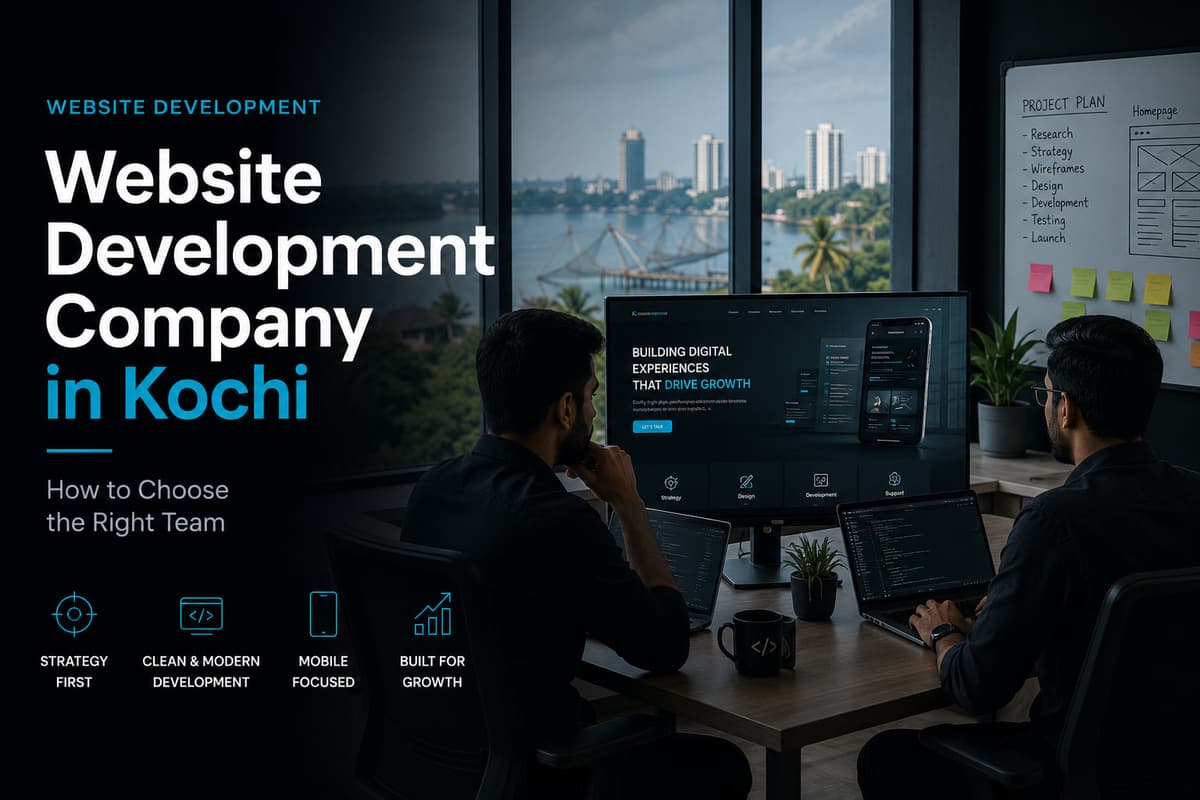
Choosing a website development company in Kochi is an important business decision. Your website may become the first place where customers learn about your company, compare your services, evaluate your credibility, and decide whether to contact you.
A visually attractive website is valuable, but appearance alone is not enough. The website should also load quickly, work properly on mobile devices, communicate your services clearly, support Google visibility, and make it easy for visitors to enquire.
Before selecting a development partner, businesses should evaluate the team’s strategy, technical ability, previous work, communication process, and post-launch support. This guide explains what to check before making that decision.
Start With the Business Goal, Not the Design Style
Before discussing colours, animations, layouts, or technology, the development team should understand what the website needs to accomplish.
A business website may be designed to:
- Generate enquiries
- Present services professionally
- Collect WhatsApp leads
- Sell products online
- Accept bookings or payments
- Build credibility
- Support Google search visibility
- Automate customer communication
The right website structure depends on the business goal. A travel agency may need individual package pages and WhatsApp enquiry options, while an e-commerce brand may need product filtering, payment integration, and order management.
A reliable development team should ask about your customers, services, competitors, current marketing channels, and growth plans before recommending a solution.
Check Whether the Team Understands Website Strategy
Website development should begin with planning rather than immediately creating screens.
A good strategy normally covers:
- Target customer
- Primary website objective
- Page structure
- User journey
- Enquiry flow
- Content hierarchy
- Search visibility
- Technical requirements
- Future expansion
For example, visitors should be able to understand what the company offers within a few seconds. Important services should have dedicated pages, contact options should be easy to find, and the site should guide users towards a clear next action.
Webeez approaches custom web design and development in Kochi by connecting design, development, SEO structure, performance, and business goals rather than treating the website as a standalone visual project.
Evaluate Custom Development Versus Template-Based Development
Not every business requires the same development approach.
Template-based websites may work for businesses that need a simple online presence with limited functionality. However, they can become restrictive when a company needs custom layouts, unique user journeys, advanced integrations, stronger performance, or future scalability.
Custom website development allows the team to create the structure around the requirements of the business. It can provide greater control over:
- User experience
- Page performance
- Mobile responsiveness
- Brand consistency
- SEO structure
- Integrations
- Security
- Future features
Businesses comparing both approaches can also read our guide on choosing a custom web design company in Kochi before making a decision.
The best option depends on the project’s purpose, timeline, budget, and long-term plans—not simply on which method is cheaper initially.
Review Real Projects, Not Only Design Mockups
Before hiring a website development company, review websites that the team has actually completed.
A portfolio should demonstrate more than visual creativity. Check whether the websites:
- Work smoothly on mobile devices
- Load without unnecessary delays
- Explain the business clearly
- Have logical navigation
- Include strong enquiry paths
- Maintain design consistency
- Use readable typography
- Support real business requirements
Case studies are especially useful because they show how the team approached a particular industry or problem.
For example, the Trawenture travel website case study demonstrates a travel-focused website structure created around tour packages, destination discovery, SEO visibility, and customer enquiries.
The Costyle Kochi e-commerce website case study provides another example of how website structure and presentation can be adapted for a fashion and online shopping business.
Relevant work is usually more meaningful than the number of projects displayed in a portfolio.
Confirm That the Website Will Be SEO-Ready
A website does not automatically rank on Google merely because it looks attractive. Search visibility depends on the website’s technical foundation, content structure, relevance, authority, and competition.
An SEO-ready website should normally include:
- Clear page titles and descriptions
- One logical main heading per page
- Search-friendly URL structure
- Dedicated service pages
- Internal links
- Image alt text
- Mobile-friendly layouts
- Fast loading
- Canonical URLs
- Sitemap support
- Structured data where appropriate
- Indexable content
The development company should understand how website structure affects future SEO work. Building every service into a single page may make it harder to target different customer searches.
A better approach may involve dedicated pages for major services, locations, case studies, and useful business-focused articles.
Test Mobile Responsiveness and Website Performance
Most customers will not experience your website only on a desktop computer. The website must work properly across mobile phones, tablets, laptops, and different screen sizes.
Responsive development should ensure that:
- Text remains readable
- Buttons are easy to tap
- Menus work correctly
- Images scale properly
- Forms remain usable
- Sections do not overlap
- Important calls to action remain visible
Performance matters as well. Large images, unnecessary scripts, excessive animations, and poor development practices can slow down the website.
Ask the company how it handles image optimization, code efficiency, loading behaviour, mobile testing, and performance checks before launch.
Animations can create a premium experience, but they should support the story of the website rather than reduce usability or speed.
Make Sure the Website Is Built to Generate Enquiries
A business website should help visitors move from interest to action.
Depending on the business, conversion features may include:
- Contact forms
- WhatsApp buttons
- Click-to-call options
- Quote request forms
- Appointment booking
- Package enquiry forms
- Product purchase options
- Online payments
- Lead qualification questions
The placement and wording of these actions are important. A generic contact button hidden at the bottom of a page may not produce the same result as a relevant CTA placed after a service explanation.
Many businesses invest in a website but do not create a clear customer journey. Our related article explains why many Kerala business websites fail to generate leads and what can be improved.
Ask About Content Management and Future Scalability
A website should not become difficult to manage after launch.
Before development begins, clarify who will be responsible for updating:
- Service information
- Blog posts
- Images
- Products
- Tour packages
- Team profiles
- Testimonials
- Contact details
The website should also be capable of supporting reasonable future growth.
A business may later require:
- Additional service pages
- E-commerce functionality
- Payment integration
- Booking systems
- CRM integration
- WhatsApp automation
- AI chatbot
- Multilingual content
- Customer dashboards
- New branch or location pages
Discussing these possibilities early can help the development team choose a suitable architecture and avoid unnecessary rebuilding later.
Understand the Development Process
A professional website project should follow a clear process.
Although workflows vary, the project may include:
- Requirement discovery
- Competitor and audience review
- Sitemap planning
- Content planning
- Wireframes or design direction
- UI design
- Development
- Mobile optimization
- Content integration
- Testing and quality assurance
- SEO and analytics setup
- Launch
- Post-launch support
Ask what deliverables are included at each stage and how approvals will be handled.
You should also know:
- Who your main contact person will be
- How progress will be communicated
- How revisions are managed
- What information you must provide
- How delays or scope changes are handled
- What happens after launch
A documented process reduces misunderstandings and creates clear expectations for both sides.
Clarify Website Ownership and Technical Access
Website ownership should be discussed before the project starts.
Confirm who will own or control:
- Domain name
- Hosting account
- Website source code
- Content
- Images and design assets
- Analytics property
- Search Console property
- Business email accounts
- Third-party subscriptions
Your business should receive the access required to manage essential digital assets.
Also ask whether the quotation includes recurring expenses such as hosting, paid plugins, third-party tools, APIs, maintenance plans, or software subscriptions. Understanding these expenses early helps avoid unexpected costs after launch.
Check Post-Launch Support and Maintenance
Launching the website is not always the end of the project.
Websites may need continued attention for:
- Software updates
- Security checks
- Backups
- Bug fixes
- Performance monitoring
- Content updates
- Integration changes
- Browser compatibility
- New features
Ask what type of support is included immediately after launch and whether ongoing maintenance is available.
The agreement should clarify which issues are covered as bug fixes and which requests will be treated as additional development.
Questions to Ask Before Hiring a Website Development Company
Before confirming the project, ask the development team these questions:
- What website approach do you recommend for our business, and why?
- Will the website be custom-developed or template-based?
- How will the site support enquiries or sales?
- Will it be mobile-responsive?
- What SEO foundations are included?
- Can we update the website after launch?
- Who will own the source code and technical accounts?
- What third-party expenses should we expect?
- What is the development and approval process?
- What support is available after launch?
- Can the website be expanded later?
- Can you show relevant live projects or case studies?
A capable team should answer these questions clearly without relying on vague technical language.
Warning Signs to Watch For
Be cautious when a website provider:
- Promises guaranteed Google rankings
- Does not ask about business goals
- Cannot show relevant completed work
- Avoids explaining the development process
- Provides no clarity about ownership
- Uses the same design for every business
- Ignores mobile usability
- Does not discuss content
- Adds unexpected recurring charges later
- Offers no testing or post-launch support
The lowest quotation is not always the lowest long-term cost. A website that later requires complete redevelopment can become more expensive than building the right foundation initially.
Why Work With a Website Development Team in Kochi?
A Kochi-based business may benefit from working with a team that understands the local market, communication style, customer behaviour, and competitive environment.
Local understanding can be especially useful for businesses targeting customers across Kochi and Kerala. However, location alone should not determine the decision.
The final choice should still be based on:
- Quality of work
- Strategic thinking
- Technical capability
- Communication
- Transparency
- Reliability
- Understanding of business goals
The right partner should combine local market awareness with professional design and development standards.
Choosing the Right Website Development Partner
The best website development company is not necessarily the team with the largest portfolio or the lowest price. It is the team that understands what the business needs and can translate that requirement into a clear, reliable, and scalable website.
Before hiring, evaluate:
- Strategy
- Design quality
- Development quality
- Mobile experience
- Performance
- SEO foundation
- Conversion flow
- Relevant case studies
- Ownership terms
- Support
A well-developed website should become a long-term business asset rather than simply an online brochure.
Webeez builds business websites with a focus on custom user experience, SEO-ready structure, responsive development, performance, and enquiry generation.
To discuss your website requirement, contact Webeez for a project consultation.