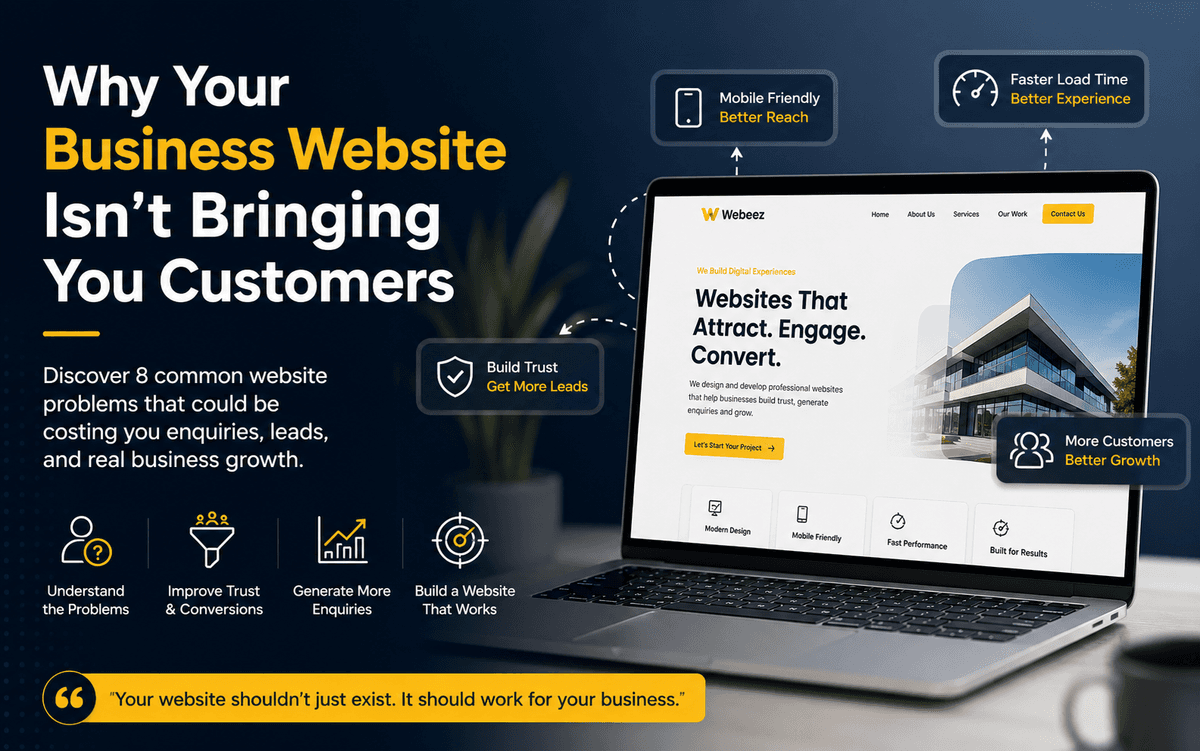
Your Website Should Do More Than Exist
A website is often the first place a potential customer goes to learn about your business.
But simply having a website does not guarantee results.
You may have a beautiful homepage, your services listed, and your contact details displayed — yet still receive very few enquiries.
The problem may not be your business.
It may be the way your website is designed to turn visitors into customers.
A successful business website should not simply act as an online brochure. It should communicate your value, build trust, answer important questions, and guide visitors toward taking action.
Your Website Looks Good, But Doesn't Communicate Clearly
Good design is important, but visual appeal alone cannot make a website effective.
When someone lands on your website, they should immediately understand:
- What your business does
- Who you serve
- What makes you different
- Why they should choose you
- What they should do next
If visitors have to search for these answers, there is a good chance they will leave before contacting you.
A strong website combines visual design with clear communication. For businesses looking to improve their digital presence, Web Design & Development should go beyond visual appeal. The structure, user experience, performance, content and conversion paths should all work together to support real business goals.
2. There Is No Clear Call to Action
One of the most common website problems is making visitors guess what to do next.
Should they call you?
Send a WhatsApp message?
Request a quotation?
Book an appointment?
Visit your showroom?
Your website should make the next step obvious.
Strategically placed calls to action such as Get a Quote, Book a Consultation, Contact Us, or Start a Project can turn passive visitors into potential customers.
3. Your Website Is Not Designed for Mobile Users
A large portion of your potential customers may discover your business through a smartphone.
If your website is difficult to navigate on mobile, has tiny text, slow-loading sections, poorly positioned buttons, or a confusing layout, visitors may leave within seconds.
A professional website should provide a smooth experience across phones, tablets, laptops, and desktop screens.
Responsive design is no longer an optional feature. It is a basic requirement for a modern website.
4. Your Website Is Too Slow
People are not very patient online.
Large images, unnecessary animations, poorly optimized code, excessive plugins, and weak hosting can all contribute to slow loading times.
Even if your website looks impressive, a slow experience can negatively affect user engagement and conversions.
Performance should be considered during the design and development process — not treated as an afterthought.
5. Your Website Doesn't Build Enough Trust
Before contacting a business, visitors often look for reasons to trust it.
Your website can build that trust through:
- Client testimonials
- Case studies
- Previous projects
- Professional Brand Identity Design
- Clear contact information
- Business information
- Relevant certifications or credentials
- High-quality photography and content
A visitor should feel confident that they are dealing with a legitimate and professional business. Seeing real projects can also help potential customers understand the quality and approach behind a business. You can explore Our Works to see examples of Webeez projects across web design, branding, e-commerce and digital experiences.
6. Your Website Doesn't Reflect Your Brand
Your website and your brand should feel like they belong to the same business.
Inconsistent colours, typography, imagery, messaging, and visual style can make even a good business appear less professional.
A strong digital presence connects branding and web design into one consistent experience.
Your website should communicate the personality and positioning of your business before a customer even speaks to you.
7. Your Content Talks About You — Not Your Customer
Many business websites focus heavily on what the company does.
But customers are usually more interested in what the business can do for them.
Instead of simply saying what services you provide, explain the problems you solve, the outcomes you create, and why your approach is different.
The goal is not just to fill pages with information.
The goal is to make the right visitor think:
“This is exactly what I was looking for.”
8. Your Website Was Built Without a Strategy
This is often the biggest problem.
A website can have great visuals, good content, and modern technology — but still fail if there is no clear strategy behind it.
Before designing a website, you should understand:
- Who the target audience is
- What the business wants to achieve
- What actions visitors should take\
- How the brand should be positioned
- What information customers need
- How the website will support marketing and growth
Design should follow strategy, not replace it.
Your Website Should Work for Your Business
A website should be more than a digital address.
It should help your business communicate better, build credibility, generate enquiries, and create opportunities.
If your current website is not generating the results you expected, the answer may not be to simply add more pages or change the colours.
It may be time to rethink the strategy behind the entire digital experience.
At Webeez, we believe a website should combine strategy, design, technology, and brand identity to create a digital presence that works for the business.
Ready to Build a Website That Works?
Whether you're launching a new business, redesigning an outdated website, or trying to improve an existing digital presence, the right strategy can make a significant difference.
If you're planning a new website or redesigning an existing one, you can Contact Webeez to discuss your goals, requirements and the right digital approach for your business. Build a digital presence that doesn't just look good — make it work for your business.