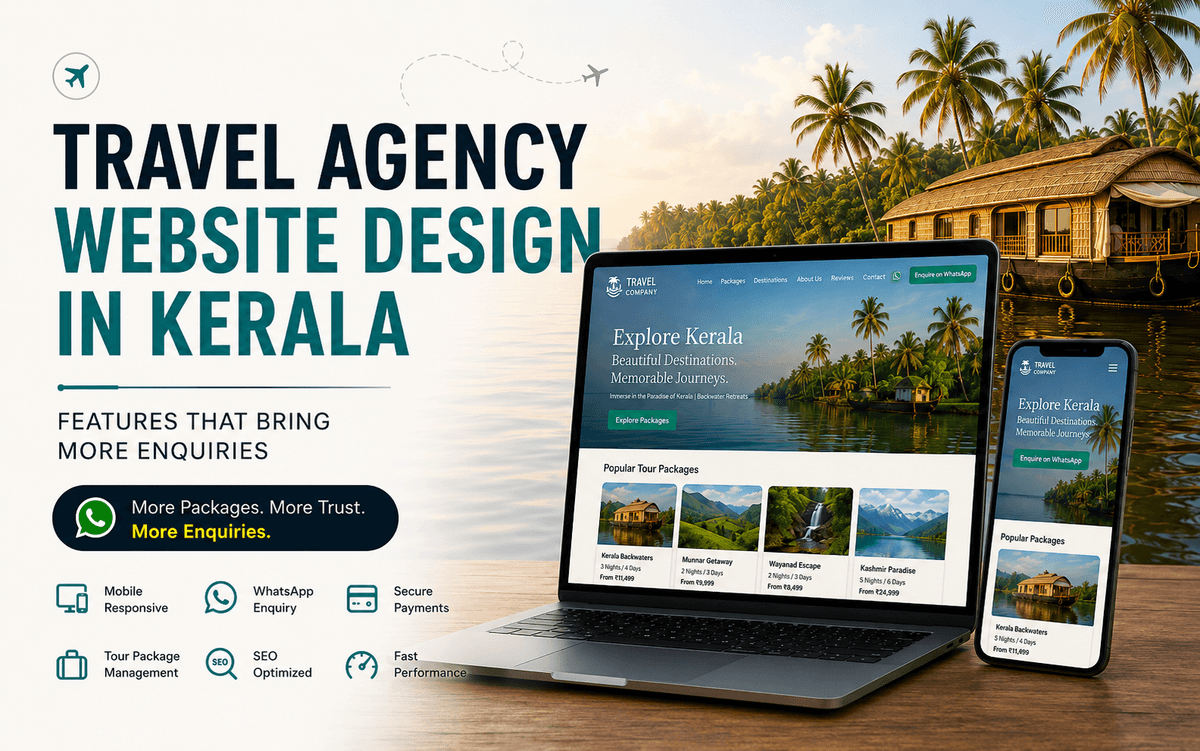
Kerala’s travel industry is highly visual, competitive and dependent on customer trust. Before contacting a travel agency, most travellers want to see destinations, package details, photographs, reviews, prices and the reliability of the company. A professionally designed website brings all this information together and helps turn interested visitors into genuine enquiries.
However, simply having a website is not enough. An outdated layout, slow mobile experience, unclear package information or a hidden enquiry button can make potential customers leave within seconds. Effective travel agency website design in Kerala must combine attractive presentation with speed, trust, search visibility and an easy enquiry process.
For travel businesses that want a professionally planned digital presence, choosing the right team for custom web design and development in Kochi can make a significant difference in how visitors experience the brand and respond to its tour packages.
Subheading: Why Travel Agencies in Kerala Need More Than Social Media
Instagram, Facebook and WhatsApp are valuable marketing channels for travel agencies. They help businesses publish photographs, videos, offers and customer experiences quickly. But social media profiles alone do not give customers a structured way to explore every package, compare options or verify the credibility of a company.
Posts also have a short lifespan. A tour package published several months ago can become difficult for a customer to find again. A website creates a permanent and organised destination where every important package, service, review and contact option remains accessible.
A good travel website also gives the business greater control. The agency owns the content, page structure, branding and customer journey rather than depending entirely on the design and algorithm of a third-party platform.
Subheading: Essential Features of a High-Converting Travel Agency Website
A travel agency website should do more than display beautiful destination photographs. Every section should help answer customer questions and guide visitors towards the next step.
The following features are particularly important for travel agencies and tour operators in Kerala.
1. Mobile-First and Responsive Website Design
A large percentage of travellers discover tour packages while browsing on their phones. They may arrive through Google Search, Instagram, a WhatsApp message or an advertisement. The website must therefore work smoothly on smaller screens.
A mobile-first travel website should include:
- Readable text without requiring zooming
- Fast-loading images and videos
- Large and clear enquiry buttons
- Easy navigation between packages
- Tap-to-call and WhatsApp actions
- Forms that are simple to complete
- Package details arranged in a scannable format
The mobile version should not feel like a reduced copy of the desktop website. It should be designed around the way customers actually browse, compare and enquire from their phones.
2. Separate Pages for Every Important Tour Package
Placing all packages on a single page may appear convenient, but it limits both user experience and SEO potential. Each important tour package should have its own dedicated page.
For example, a Kerala travel agency may create separate pages for:
- Kashmir tour packages
- Kerala honeymoon packages
- Munnar holiday packages
- Alappuzha houseboat experiences
- Wayanad family packages
- International holiday packages
- Corporate group tours
- Student or educational tours
Each package page can contain its own itinerary, duration, highlights, photographs, inclusions, exclusions, frequently asked questions and enquiry form.
Dedicated pages also make it easier to share a specific package through WhatsApp or social media. Instead of sending customers to a general home page, the agency can send them directly to the most relevant offer.
This page-based approach is one of the most important principles behind effective tour package website design in Kerala.
3. Clear Itinerary and Package Information
Customers should not have to call the agency simply to understand the basic structure of a package. Important information must be presented clearly before the enquiry stage.
A well-structured package page should explain:
- Package name and destination
- Number of days and nights
- Starting location
- Day-by-day itinerary
- Accommodation category
- Transportation details
- Meals included
- Sightseeing activities
- Package inclusions
- Package exclusions
- Cancellation or booking conditions
- Starting price or request-for-quote option
- Available customisation
Transparent information reduces repetitive questions and helps the agency receive enquiries from customers who already understand the offer.
It is also important to keep the writing original. Copying the same itinerary from another travel website can reduce credibility and make it harder for the page to perform well in search results.
4. Prominent WhatsApp and Enquiry Options
Travel decisions often require discussion. Customers may need to change dates, hotel categories, pickup points, traveller counts or the overall budget. For that reason, many travel websites should prioritise enquiry generation rather than forcing every visitor into an instant booking process.
Every package page should have a clear action such as:
- Enquire on WhatsApp
- Request a Custom Quote
- Talk to a Travel Expert
- Check Availability
- Plan This Trip
- Call Now
The enquiry button should remain easy to access throughout the page, especially on mobile devices.
When the customer clicks WhatsApp, the website can also prepare a message containing the package name. This helps the agency immediately understand what the customer is interested in.
For example: Hello, I would like to know more about the 5-Day Kashmir Honeymoon Package listed on your website.
This is more useful than receiving a generic message such as “Hi” without any package context.
5. Strong Visual Storytelling
Travel is an emotional purchase. Customers imagine themselves experiencing the destination before they decide to enquire. High-quality photographs, videos and thoughtful content can help create that emotional connection.
A travel website can use:
- Destination photography
- Short experience videos
- Hotel photographs
- Vehicle or transport images
- Activity galleries
- Customer trip photographs
- Maps and route visuals
- Mobile-friendly image sliders
However, uploading large, unoptimised photographs can make the website slow. Images should be compressed, displayed in modern formats and loaded according to the visitor’s screen size.
Visual content must support the package rather than distract from the enquiry process.
6. Reviews and Trust Signals
Customers are often cautious before transferring money to a travel company. A website must therefore provide enough evidence that the agency is genuine, accessible and experienced.
Useful trust elements include:
- Google review ratings
- Written customer testimonials
- Customer photographs with permission
- Video testimonials
- Business registration details where appropriate
- Office address and map
- Clear phone and WhatsApp numbers
- Professional business email
- Social media links
- Secure website connection
- Transparent booking policies
Reviews should be placed near relevant packages and important decision points instead of being hidden only on a separate testimonial page.
The website should avoid displaying unverifiable awards, exaggerated claims or fake counters. Genuine proof is more valuable than impressive-looking but unsupported numbers.
7. Fast Website Performance
Beautiful design has limited value when the website takes too long to load. Travel websites commonly become slow because they contain large images, autoplay videos, sliders, external scripts and tracking tools.
A slow website can result in:
- Visitors leaving before viewing a package
- Lower conversion from advertisements
- Poor experience on mobile data
- Reduced search visibility
- Fewer completed enquiry forms
Performance-focused travel website development should include image compression, modern image formats, controlled video loading, efficient code, caching and reliable hosting.
The home page does not need to load every available package and photograph at once. Content can be prioritised so that customers see the most important sections first.
8. SEO-Ready Destination and Package Pages
A website should help customers find the agency when they search for specific destinations or package types on Google.
Instead of relying only on a broad home page, the website can target relevant searches through dedicated content such as:
- Kerala honeymoon tour packages
- Kashmir packages from Kerala
- Munnar family tour packages
- Alappuzha houseboat packages
- Kerala group tour operators
- International tour packages from Kochi
Each page should have a unique title, description, heading structure, original content and relevant internal links.
Travel agencies can also publish helpful articles about destinations, seasons, costs, itineraries and travel planning. These articles can attract customers earlier in the research process and guide them towards suitable package pages.
SEO should be included during website planning rather than treated as an addition after development is complete.
9. Easy Package Management Through a CMS
Travel packages change regularly. Prices, hotel options, travel dates, photographs and itineraries may need frequent updates. Depending on a developer for every small content change can create unnecessary delays.
A suitable content management system should allow authorised staff to:
- Create new packages
- Edit itineraries
- Update prices
- Add or remove photographs
- Change package availability
- Manage reviews
- Publish travel articles
- Update FAQs
- Modify SEO titles and descriptions
The admin experience should be simple enough for the travel team to use without technical knowledge. At the same time, roles and permissions should protect sensitive settings from accidental changes.
10. Online Payment or Advance Booking Options
Not every travel agency needs a complete real-time booking engine. Many packages require custom quotations because prices depend on travel dates, group size, hotel selection and transportation.
A practical approach is to combine enquiries with an advance payment option.
The process can work like this:
- Customer submits an enquiry.
- Agency confirms the itinerary and final price.
- Customer receives a secure payment link.
- Customer pays an advance amount.
- Agency confirms the reservation.
For fixed packages or activities, the website can provide a direct payment option through a gateway such as Razorpay. The correct approach depends on the business model and how often packages require customisation.
Online Booking or Enquiry-Based Website: Which Is Better?
A complete booking engine works well when availability, pricing and inventory can be standardised. This may suit hotels, scheduled activities, transport tickets or fixed-departure packages.
An enquiry-based website is often more practical when:
- Customers request customised itineraries
- Prices change according to travel dates
- Hotel availability must be confirmed manually
- Group size affects the quotation
- Multiple transport options are available
- The agency wants to speak with customers before payment
Many Kerala travel agencies benefit from a hybrid model: detailed package pages, fast WhatsApp enquiries and a secure payment option after confirmation.
The website architecture should match the actual sales process instead of adding a complicated booking system that the team may not use effectively.
Recommended Website Structure for a Kerala Travel Agency
A practical travel agency website may include the following pages:
Home Page
Introduces the agency, primary destinations, popular packages, reviews and enquiry options.
Tour Packages
Organises packages by destination, package type, traveller category or duration.
Individual Package Pages
Provides complete itinerary, images, inclusions, exclusions, pricing guidance and enquiry actions.
Destinations
Introduces important destinations and connects visitors to related packages.
Experiences or Activities
Showcases houseboats, trekking, village experiences, adventure activities, cruises or other specialised offerings.
About the Agency
Explains the company story, expertise, location and approach to customer service.
Reviews
Displays genuine customer experiences and social proof.
Travel Insights or Blog
Publishes helpful destination guides, travel tips, seasonal information and itinerary ideas.
Frequently Asked Questions
Answers common questions about booking, payment, cancellation, customisation and support.
Contact Page
Provides phone, WhatsApp, email, office location, map and enquiry form.
The final structure should depend on the agency’s services and the way customers normally book.
Lead Follow-Up and Travel Enquiry Automation
Generating an enquiry is only the first step. Travel businesses can lose potential customers when replies are delayed or follow-ups are forgotten.
A structured lead system can help the agency:
- Record enquiries from the website
- Identify the package requested
- Send an immediate acknowledgement
- Notify the correct team member
- Schedule follow-up reminders
- Organise leads according to status
- Send approved itinerary or payment information
- Track whether the customer has responded
Businesses exploring more advanced workflows can connect their website with AI automation services in Kochi to improve enquiry handling, qualification and follow-up without removing the human element from travel planning.
Automation should support the sales team, not send uncontrolled or misleading responses to customers.
Common Travel Website Mistakes to Avoid
Travel agencies should avoid the following problems:
- Using the same content for every package
- Uploading low-quality or misleading images
- Hiding WhatsApp and phone contact options
- Publishing packages without inclusions and exclusions
- Using large videos that slow down mobile loading
- Displaying outdated prices
- Sending every visitor to the home page
- Creating a complicated booking process
- Using fake reviews or unverifiable claims
- Building a website without content management access
- Ignoring SEO titles and page descriptions
- Launching without testing forms and payment flows
A professional website development company in Kochi should test the complete customer journey across mobile and desktop devices before the website goes live.
What to Ask Before Hiring a Travel Website Development Team
Before selecting a developer or agency, a travel business should ask:
- Will every important package have a separate page?
- Can our team update packages without coding?
- Will the website work properly on mobile devices?
- Are WhatsApp and call actions included?
- Can online payment be added?
- Will the website be prepared for SEO?
- Who owns the domain, hosting and website code?
- Are analytics and enquiry tracking included?
- How will images and videos be optimised?
- Is post-launch support available?
- Will forms and payment flows be tested?
- Can new destinations and packages be added later?
The development team should understand the agency’s sales process before recommending technology or features.
How Webeez Approaches Travel Website Design
Webeez builds travel websites around clarity, visual storytelling, performance and enquiry generation. Instead of treating the website as a digital brochure, the structure is planned to help customers discover suitable packages and contact the travel team without unnecessary friction.
The Trawenture travel website project demonstrates how destination-focused design and tour package presentation can be brought together within a professional travel website experience.
Depending on the project, a travel website can include:
-Custom responsive design
- Destination and package management
- WhatsApp enquiry integration
- Online payment options
- SEO-ready page structure
- Image and video galleries
- Customer reviews
- Travel articles
- Content management
- Analytics and enquiry tracking
The final feature set should be selected according to the business model, available content and budget rather than adding unnecessary complexity.